

25 Jun Solar self-consumption for businesses: When does it become profitable? 6 key indicators
Energy costs have become a major expense for many businesses. Whether you’re a factory, a shop, a farm, or an office, your electricity bill is a key factor to consider when calculating costs and trying to improve profitability. That’s why some companies are starting to switch to solar photovoltaic self-consumption as a way to reduce costs, gain energy independence, and improve their competitiveness.
We could say that solar self-consumption for businesses is profitable when the monthly electricity bill exceeds €500, consumption is concentrated during daylight hours, and the company has sufficient stability to plan for a 5-6 year payback period. If these conditions are met, a photovoltaic installation can reduce energy bills by between 40% and 70%.
In this article we analyze 6 indicators that explain why your company should switch to photovoltaic energy.
What is solar self-consumption for businesses?
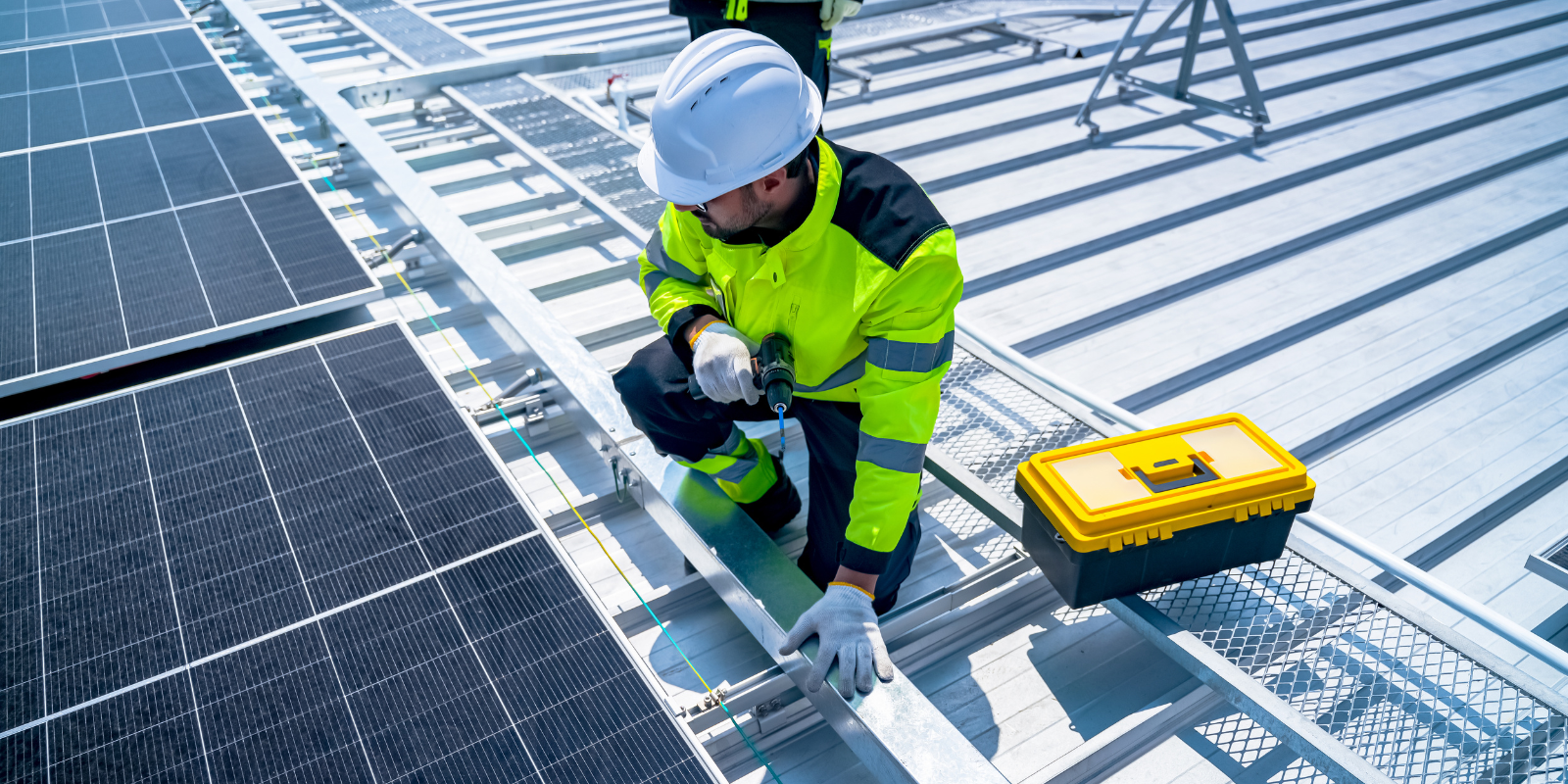
Business solar self-consumption involves producing electricity by installing solar panels on a company’s premises—such as an industrial roof, parking lot, or land—thus reducing dependence on the grid. The energy produced is consumed directly; any surplus can be fed back into the grid (with financial compensation) or stored in batteries.
Unlike residential self-consumption, industrial installations have greater power (from 10 kW to several MW), greater absolute savings and access to more significant tax deductions.
Indicator 1: Your electricity bill keeps growing
If you notice that electricity costs make up a significant portion of your operating expenses each month, self-consumption can help you control that situation.
According to real-world business case studies, with a monthly electricity bill of €500 (€6,000 per year), a properly sized photovoltaic system can cover between 40% and 70% of consumption, resulting in annual savings of between €2,400 and €3,600. Therefore, the payback period is generally between 5 and 6 years.
If your bill is even higher, the savings will be greater; for example, if your bill is above €1,500-€2,000/month, the annual savings can exceed €10,000 and the amortization can be brought forward to 4-6 years.

Indicator 2: Your company primarily consumes electricity during the day
Solar installations generate their energy during daylight hours, making them especially cost-effective for businesses that operate during daylight hours. If this is not the case, the implementation of electrical storage systems such as batteries must be considered.
We would be talking about all types of businesses: workshops and industrial buildings, agricultural and livestock farms, service companies, hotels, offices or shops or factories in general.
Peak solar energy production hours in Spain are between 9:00 and 18:00, with the highest peak between 11:00 and 15:00. If your business is operating at full capacity during this time, you can directly utilize the generated energy without needing batteries.
The more consumption times coincide with solar production, the greater the use of the energy generated and the faster the return on investment.
A company that operates Monday to Friday from 8:00 a.m. to 6:00 p.m. can consume 80-90% of its production. A company with night shifts or highly irregular consumption will reduce that percentage and take longer to recoup its investment.
Indicator 3: Do you have available surface with good orientation: roofs, decks or unused land?

These spaces allow the installation of photovoltaic systems without affecting the company’s daily operations and by taking advantage of existing infrastructure.
The general rule is that each kilowatt peak (kWp) of installed power requires between 5 and 6 m² of usable surface area.
A 20 kWp installation—suitable for an SME with a monthly bill of €800-1,200—requires between 120 and 160 m². An industrial building or parking lot of that size is sufficient.
The optimal orientation in Spain is south-facing, with a tilt between 25° and 35°. Southeast and southwest orientations have a yield loss of only 5-10%, making them equally viable. Roofs facing north or with significant shade from trees or adjacent buildings considerably reduce production.
Indicator 4: You have the resources to make investments to increase your company’s profitability
Not all investments generate such a clear and measurable return as a self-consumption installation, although this is a long-term investment.
While other expenses may be difficult to quantify, energy savings can be calculated from the outset, allowing you to know approximately: the expected cost reduction, the payback period, and the return on investment.
Current photovoltaic panels have a guaranteed lifespan of 25-35 years, with performance degradation of less than 0.5% per year according to leading manufacturers.
The profitability of a solar photovoltaic installation isn’t realized in the first year, but rather cumulatively. A company with a lease expiring in two years, or one in the process of relocating, isn’t the ideal candidate. In contrast, a company that owns its facilities or has long-term leases can confidently plan for amortization.
Indicator 5: You want to improve your company’s competitiveness and image
Investing in renewable energy not only saves money but also improves a company’s image. More and more customers value companies’ environmental commitment.
A company that focuses on self-consumption conveys values such as innovation, sustainability, environmental responsibility, and efficiency.
Indicator 6: Your energy costs have risen and you are looking for independence from the electricity market
The price of electricity in Spain has been highly variable in recent years, and this affects companies that have fixed prices, which they have to renew under demanding conditions, or not, leaving them unprotected against unforeseen increases.
Solar self-consumption protects the company against these price increases since the company generates its own energy (all or a large part of it) at zero cost.
Do you meet 3 or more of these signs?

Each company has different energy needs, so it is important to carry out a personalized study that takes into account current electricity consumption, activity schedules, available space and savings objectives.
At GenPower, we help businesses, industries, and farms find the most efficient energy solution for each situation, designing installations tailored to their specific needs. If you want to know if your company needs a photovoltaic solar installation, we can conduct a personalized feasibility study for your particular circumstances.
Start saving energy and gaining independence
A self-consumption installation is not just an investment in renewable energy. It’s a commitment to the stability, competitiveness, and future of your company.
At GenPower, we conduct free, no-obligation feasibility analyses for businesses and industrial facilities in Lleida and throughout Catalonia. We analyze your energy consumption, your existing facilities, and the available subsidies to provide you with a realistic scenario of potential savings and return on investment.
No Comments