


18 Sep Virtual battery, also called a solar wallet or piggy bank, for your second home
Are you thinking about installing solar panels at your vacation home but unsure what to do with the electricity produced when you’re not using it? A second home can generate a lot of solar energy precisely when you’re using it least. During the months the house is closed, the panels continue to generate electricity. Best of all, a good portion of that production can be converted into savings thanks to a virtual battery that allows you to accumulate the solar energy your second home produces while it’s unoccupied as a credit, which can then be deducted from your bill when you return.
Why does a second home generate so much surplus?
A primary residence and a second home have very different consumption patterns. In a house used occasionally (in the Pyrenees of Lleida or on the coast of Tarragona, for example), the solar installation continues to produce energy every sunny day, but actual consumption is concentrated in a few weekends or during holiday periods (summer, Easter, etc.). The rest of the time, almost all of that production is fed into the grid.
Without a compensation mechanism, these surpluses are lost or compensated at a very low price set by the energy supplier. With a virtual battery, however, they accumulate as credit that you can use yourself later, even in another home if the system allows it. Some suppliers allow you to apply the balance to several accounts under the same account holder. In this way, the surpluses produced at a second home can help reduce the bill for the primary residence, provided the conditions of the contracted offer are met.
The terms and conditions can vary from company to company. Some allow you to offset only the property’s electricity bill with solar panels; others offer to distribute the balance among several electricity contracts and even, in certain cases, include other utilities contracted with the company.
Therefore, before signing up, it’s advisable to check if there’s a monthly fee, how much you pay for each kWh of excess energy, whether the balance expires, and which bill items it can offset. At Soma GenPower, we can help you answer these questions.
What is a virtual drum kit?
 Unlike a physical battery, a virtual battery doesn’t store electricity: it’s a compensation system managed by your energy supplier that converts your surplus energy into accumulated monetary savings. It’s especially useful for vacation homes at the beach or in the mountains, where solar production remains active even if no one uses that energy for weeks or months.
How it works step by step
-
- The photovoltaic installation of the second home generates energy during the day, whether or not the home is in use.
- The unused portion is fed into the electrical grid, as in any installation with surplus energy.
- The energy supplier records this surplus as a credit in your virtual battery account, instead of offsetting it directly on your monthly bill.
- When you move back into the home —or during peak consumption months—, that accumulated monetary credit is deducted from your electricity bill, reducing or even eliminating the expense during periods of highest usage.
Requirements for hiring a virtual drum kit
- Self-consumption installation with surplus, registered according to Royal Decree 244/2019.
- Contract with a marketing company that offers this service (not all of them include it).
- The accumulated credit usually has conditions specific to each supplier: expiry date, accumulation limit or restrictions on transferring it to another supply point.
A simple example
Imagine a coastal house with solar panels that remains empty for much of the year. In April, the installation produces 300 kWh, but only 70 kWh are consumed. The remaining 230 kWh are fed into the grid and converted into a credit based on the agreed compensation price.
During July, the house is occupied again, and consumption of air conditioning, hot water, and appliances increases. The accumulated cash balance can be used to reduce that bill, even if production and consumption didn’t occur at the same time.
If the energy supplier allows it, the remaining balance could also be applied to the main residence or another associated supply point.
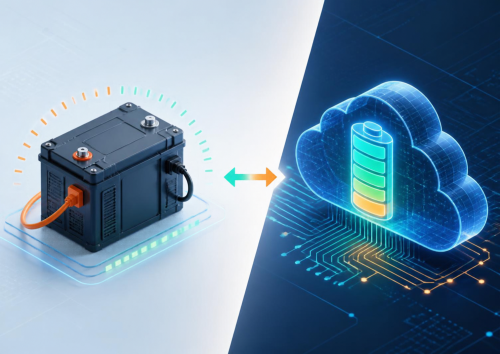
Virtual battery or physical battery: which is better for a second home?
| Virtual battery | Physical battery | |
|---|---|---|
| What it stores | Economic credit, not electricity | Real electricity in a physical device |
| Initial investment | None or very low (service provided by the energy supplier) | High (several thousand euros depending on capacity) |
| Maintenance | It does not require | Periodic inspections, limited useful life |
| Yield on empty housing | Take advantage of 100% of the surplus as credit | It gets clogged up quickly if there’s no consumption to empty it. |
| Ideal for | Occasional use homes, second homes | Homes used regularly with daily consumption |
What to check before hiring
Not all virtual batteries work the same. Before choosing, check these points:
- Price of surplus energy: some companies apply a fixed price, while others link it to the electricity market. For example, some offers calculate the balance by multiplying the surplus kWh by a variable price.
- Service fee: a no monthly fee may be more convenient if the home generates few surpluses.
- Compensation limit: some conditions state that the balance cannot exceed the value of the energy consumed in the bill.
- Associated properties: confirm if you can include your main residence and if both must be in the name of the same owner.
- Balance expiry: check if the accumulated amount has an expiry date.
- Offsettable concepts: the balance is usually applied mainly to the energy term, but does not necessarily eliminate taxes, meter rentals or other regulated charges.
- Tariff changes: check what happens if you switch energy providers or cancel your contract.
A more efficient way to make your second home profitable
In conclusion, installing solar panels on a home used only occasionally doesn’t mean you have to accept months of wasted energy. With a virtual battery, solar production can be converted into a financial advantage to use when the house is occupied or to reduce consumption of other utilities.
The key is to carefully compare the terms: compensation price, fees, limits, expiration date, and the possibility of sharing the balance between properties. This way, you can transform a house that’s empty for much of the year into a source of year-round energy savings.
At Soma GenPOwer, we can help you compare and contract your virtual battery, and we also specialize in photovoltaic solar installations for second homes. Our professionals will help you decide which installation is best for your property and what type of battery is best for the days you’re away—virtual or physical. Contact us and we will advise you.
Frequently Asked Questions
Does a virtual battery replace a physical battery at home?
Not necessarily. It solves the same problem—what to do with the excess energy you don’t use immediately—but without investment in equipment or maintenance. For frequent nighttime consumption, a physical battery still makes sense; for a home that’s empty for most of the year, a virtual one is usually more cost-effective.
Does the virtual battery credit expire?
It depends on the energy provider. Some maintain it indefinitely as long as the contract is active; others apply a time limit. It’s advisable to check before signing up.
Can I use the credit generated from my second home in my primary residence?
In some cases, yes, if both properties are under contract with the same energy provider and the service expressly allows it. It’s not a standard condition in all contracts.
Do I need to register anything special if my second home already has self-consumption with surplus energy?
Simply contract the virtual battery service with your energy supplier; the photovoltaic installation does not require any technical modifications.
No Comments