

29 Oct Artificial intelligence and electricity supply: what changes in grid-connected and isolated installations
Artificial intelligence is a technology with many applications that is transforming very different sectors (industry, services, how we manage resources); and one of the most important is energy.
The emergence of artificial intelligence in the energy sector has had two impacts: on the one hand, when properly applied, it can make facilities more efficient and help improve their management, both for those connected to the grid and those that are isolated; on the other hand, it increases electricity demand due to the cost of running data centers.
How does AI affect the electricity supply?
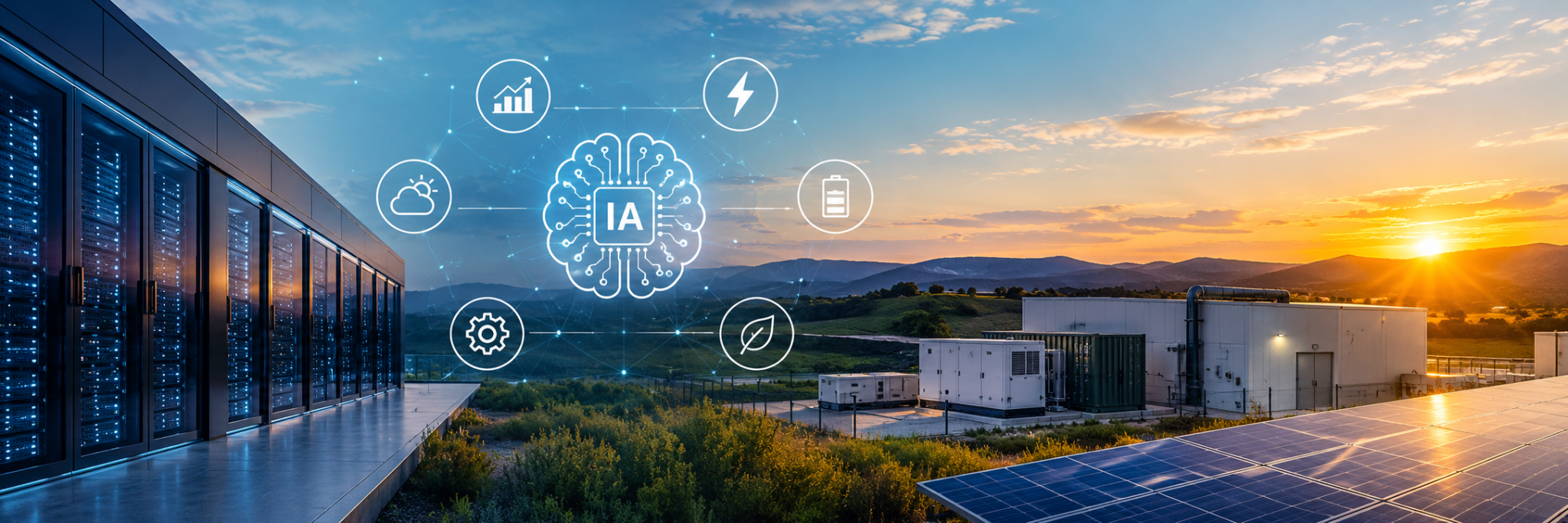
Leaving aside the function of AI as a consumer, let’s focus on its role as a tool, since its inclusion will allow us to predict how much energy we will produce and consume, make important decisions such as when to charge or discharge a battery, detect breakdowns before they occur, and operate entire systems with very little human intervention.
That’s why it’s important to include artificial intelligence in the design and management of electrical installations. But it’s important to keep in mind that the approach will differ between a grid-connected installation and an off-grid one. Let’s look at the available options.
AI in network-connected facilities
In a grid-connected installation, AI primarily helps ensure that the installation supplies the energy that will be demanded, even when demand experiences significant increases. It seeks optimization .
The incorporation of artificial intelligence systems and data analysis tools allows for improvements in various aspects:
Production and consumption forecast
AI as an energy management tool analyzes all the necessary data to calculate energy demand and plan when to consume, store surplus energy in batteries, or feed it into the grid. Among other things, AI analyzes the facility’s production history or usage patterns, consumption habits, and weather forecasts.
Battery and surplus management
For a profitable installation, the battery used to store surplus energy needs to be well managed. AI will help us decide when to charge or discharge a battery using a variable system that depends on circumstances (electricity prices, production, hours of sunlight, etc.). This way, we achieve better use of surplus energy.
Predictive maintenance
The AI constantly studies and analyzes the data that the facility provides through all the equipment and thus identifies signs of possible equipment failures before they occur and cause service interruptions.
Shared self-consumption and energy communities
AI is very useful in the case of shared consumption, neighborhood communities and energy communities, as it can fairly distribute energy taking into account the actual production and consumption of each participant.
Renewable generation management
AI can also help us in the case of energy produced by solar installations and other renewable sources by taking into account demand and generation conditions.
In summary, in the case of network-connected installations, AI can contribute to improving efficiency and planning, but it does not replace the need to correctly size the installation, protect the equipment, and guarantee the quality of supply by a good professional who includes artificial intelligence as another tool to optimize the installation.

AI in isolated facilities
In an isolated facility (a farmhouse, a farm, a livestock operation, an irrigation shed, or a home without grid access), there is no electrical connection to automatically cover production shortfalls. In these cases, the supply depends on other resources within the facility itself, such as photovoltaic generation, battery storage systems, and, when necessary, generators. This is why artificial intelligence plays a particularly important role in energy management.
Production and consumption forecast
AI allows us to predict renewable energy production based on weather forecasts and historical data.
Coordination of the different sources: solar, battery and backup
AI helps decide where to source every kilowatt-hour: combining solar power, batteries, and generators, prioritizing solar energy, using batteries when convenient, and starting the generator only when absolutely necessary. It also adapts certain equipment to available resources without compromising essential services through intelligent load management. For example, if the weather forecast predicts bad weather for the next day, AI can postpone non-urgent energy consumption to protect the installation.
Remote monitoring and diagnostics
In remote locations, the inability to easily access equipment is a problem. With remote monitoring and smart alerts, you can check battery status, detect anomalies, and take action without traveling to the site.
Fewer generator hours
As we mentioned earlier, artificial intelligence prioritizes resources, and one key consideration is minimizing the generator’s operating hours to reduce noise, fuel consumption, and the need for future maintenance or breakdowns. This is achieved through improved forecasting and more precise load management.
Networked or standalone installation: what AI brings to each case
| Connected to the network | Isolated | |
|---|---|---|
| Main objective | Save and make profit from surpluses | Guarantee supply and autonomy |
| The Role of AI | Optimize production, consumption and price | Managing limited resources without a backup network |
| Battery management | According to electricity production, consumption and price | According to weather forecast and load priority |
| Maintenance | Early detection of performance losses | Remote diagnostics in hard-to-reach locations |
| Dependence on support | The network acts as a backup. | The generator, if one exists, is used as little as possible. |
| Most visible benefit | Lower bill | Greater autonomy and less travel |
What does this mean for your installation?
- If you already have grid-connected self-consumption , check if your inverter or monitoring system includes intelligent battery management and forecasting. Many current systems already offer this feature.
- If you’re thinking about installing batteries , consider whether the system can adapt to your consumption and electricity prices, not just whether it stores energy.
- If you have (or need) an off-grid installation , sizing and load management are crucial. It’s advisable to have it designed by an experienced installer to avoid a calculation error that could be serious if there’s no backup power supply.
- In all cases , AI does not replace a good installation: a well-sized and well-installed system is the foundation on which intelligent management adds value.
Conclusion
AI doesn’t change the fundamentals of a solar installation, but it does improve how it’s managed. It also doesn’t replace a good installation. Artificial intelligence adds value, but only if it’s integrated into a properly sized and installed system.
At GenPower, we have a team of professionals ready to carry out the best installation for each project, using top-quality materials and working with energy solutions tailored to the specific needs of each installation. If you are considering a self-consumption system, batteries, or an off-grid system in Catalonia or Aragon, GenPower will analyze your situation and provide you with a free consultation. Contact us today.
Frequently Asked Questions
Does AI make my electricity bill cheaper?
It can help reduce energy costs if your facility has smart management of production, batteries, and consumption, because it makes better use of your energy and takes advantage of off-peak prices. It’s not a solution in itself: it depends on how the facility is sized and configured.
Do I need a battery to benefit from AI in my installation?
It’s not essential, but it’s where the difference is most noticeable. Without a battery, AI can help schedule energy consumption and monitor performance; with a battery, it can also decide when to store and when to use energy.
Can an off-grid installation operate without a generator?
It depends on consumption, the available solar radiation in the area, and the battery size. Proper load management helps reduce generator usage, and in some cases eliminates the need for it, but each case must be assessed individually.
Does AI increase or decrease global electricity consumption?
Both things: the data centers that power it increase demand, and at the same time AI allows for more efficient management of generation, networks, and user facilities.
How do I know which solution is right for my situation?
The most reliable approach is to start with a study of your energy consumption and location. From there, we can determine whether a grid-connected, off-grid, or battery-powered system is more suitable.
No Comments