We’re seeing more and more homeowners’ associations considering installing solar panels as a way to reduce their electricity bills, both for the building and/or for individual residents. Before taking the plunge, a common question arises: Is it worth installing solar panels, and what type is best to maximize their benefits? Individual or shared self-consumption?
The choice of self-consumption model, individual or collective, depends on many variables that must be taken into account in each case, such as the type of building, the number of interested neighbors, the common consumption, whether a solution is sought for a single dwelling, for common services or for several dwellings at the same time, etc.
Individual self-consumption involves installing solar panels for a single home or business, which consumes all the energy it generates. Shared self-consumption is based on a common solar installation that distributes the production among several neighbors, each with a fixed percentage assigned. The main difference lies in who owns the installation and how the surplus is distributed.
Individual self-consumption: advantages and limitations
When we talk about individual self-consumption, we’re referring to a photovoltaic installation that supplies a single consumer, such as a neighbor or a specific business. All the energy generated by this installation is used directly and exclusively for that home or business. This is common in single-family homes, but we also use the term “individual self-consumption” when discussing communities that want to cover only the energy consumption of common areas, such as the elevator or lobby lighting, with a single supply point. Furthermore, we also use the term “individual self-consumption” in the case of apartment buildings when an owner has their own space to install the panels, covers the installation costs, and is the sole user of the energy produced.
The positive aspects
100% autonomous decision-making and management, without depending on neighborhood agreements.
All the energy generated is for a single consumer.
Decision-making is faster.
The negative aspects
Only viable if you have your own roof or enough space.
It is not always feasible in multi-unit buildings.
The installation cost is usually higher than in shared installations, even if the latter are larger, since the costs are not shared among several consumers or owners.
Shared self-consumption: advantages and limitations
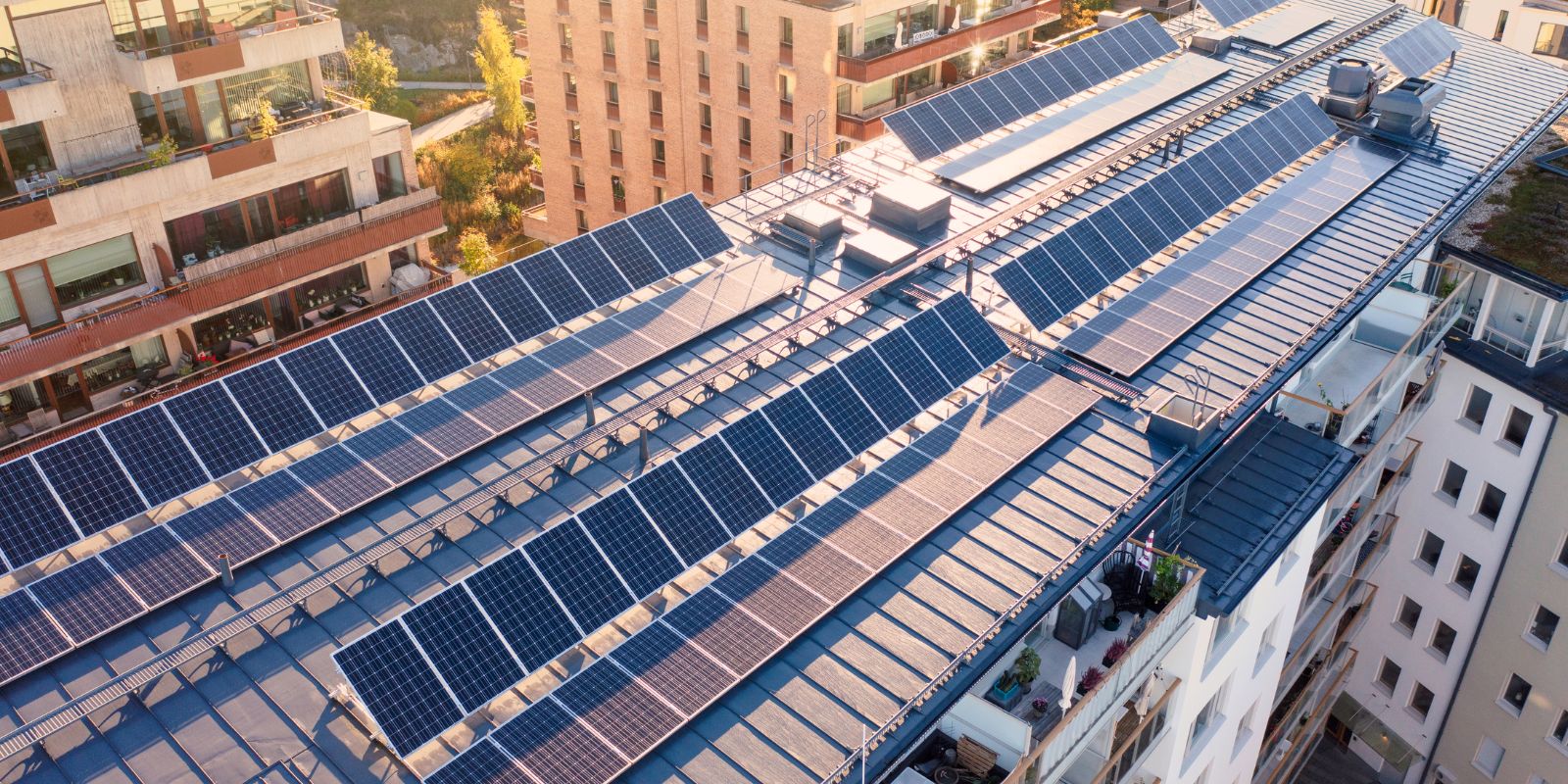
In the shared self-consumption model, a single solar installation supplies energy to several residents or to the building’s common areas. Several residents participate in the same installation, and the energy is distributed according to pre-agreed distribution coefficients. This model is designed for homeowners’ associations and allows for better use of the building’s roof, reducing the electricity bill for several households simultaneously.
The positive aspects
It allows you to generate solar energy even if you don’t have your own roof (as is the case with multi-story buildings that have a common roof).
The cost of the installation is shared among all participants, reducing individual investment.
Make better use of large rooftops of buildings and housing developments.
The negative aspects
It requires agreement from the community of owners (simple majority according to the Horizontal Property Law for self-consumption installations).
It is important to conduct a preliminary study to correctly size the installation and define the energy distribution.
The distribution of energy is set with coefficients that do not always reflect the actual consumption of each home.
The administrative procedures are longer: the distribution must be defined and registered with the distributor.
Comparative table between individual self-consumption and shared self-consumption
Individual self-consumption
Shared self-consumption
Ownership
A single home or business
Community of owners or several owners
Energy distribution
100% for a consumer
Fixed distribution coefficients among participants
Maximum distance between generation and consumption
Not applicable (same point)
Up to 5 km in low voltage networks (RD 244/2019)
Initial investment per home
Higher (individual installation)
Lower (the cost of a larger installation is shared)
Formalities
Simpler, a single headline
It requires a community agreement and a notarized or joint distribution
Ideal for
Single-family homes, villas, warehouses
Apartment buildings, housing developments, communities with shared roofs
Which one suits you best?
In most residential communities, shared self-consumption is usually the most cost-effective and efficient alternative, as it allows maximizing the use of the installation and distributing both the investment and the benefits among several users.
If only one household wants to take the plunge, or if the community is looking to start with a small, straightforward project, individual self-consumption is usually the simplest option. It requires less coordination between neighbors and is easier to manage administratively.
However, each building has different needs. The orientation of the roof, the residents’ energy consumption, the available space, and the budget are all factors that should be analyzed before making a decision.
Taking into account the type of housing, we could say that the ideal model in general terms is:
Single-family home with its own roof: individual self-consumption. It is the simplest option and with the most direct return.
Community of neighbors with a shared roof and good orientation: shared self-consumption. Reduces the entry cost for each owner.
Community with very disparate consumption between homes: it is advisable to simulate several distribution coefficients before deciding, because a poorly adjusted distribution may leave some neighbors with a surplus without taking advantage of it and others without sufficient coverage.
At Soma GenPower, we study each project individually to design the solution that best suits each community. If your community is considering switching to solar energy, we’ll help you evaluate the different options and find the most cost-effective alternative for your building.
At GenPower, we specialize in solar panel installations for both single-family homes and apartment buildings, particularly in the Lleida, Catalonia, and Huesca, Aragon areas. If you’re interested in seeing some of the photovoltaic solar installations we’ve completed, please visit our Installations section . And if you have any questions or would like our advice, please contact us .
Frequently Asked Questions
Can I switch from individual to shared self-consumption later? Yes, but it involves registering a new configuration with the distributor and, if there are multiple account holders, updating the distribution plan. It’s not a simple change of settings.
What is the maximum distance allowed by law between the installation and the homes?
Until 2025 , the general limit was 2 km for collective self-consumption via network (previously it had been 500 m and then it was extended).
Since 2026 , following the entry into force of the new regulation, the limit has been extended to 5 km to facilitate energy communities and shared self-consumption.
In addition to distance, other technical requirements must be met, such as the installation and consumers being connected in accordance with the conditions established for collective self-consumption (for example, through the distribution network and complying with regulatory criteria).
Do I need a meter per household in shared self-consumption? Yes, each participant maintains their own meter and bill, but the self-consumed energy is deducted according to the assigned distribution coefficient.
What majority is needed in a homeowners’ association to approve a shared installation? The Horizontal Property Law establishes a simple majority (favorable vote of the majority of those present) for self-consumption installations, provided that the cost does not exceed certain limits set by the law itself.
Para ofrecer las mejores experiencias, utilizamos tecnologías como las cookies para almacenar y/o acceder a la información del dispositivo. El consentimiento de estas tecnologías nos permitirá procesar datos como el comportamiento de navegación o las identificaciones únicas en este sitio. No consentir o retirar el consentimiento, puede afectar negativamente a ciertas características y funciones.
Funcional
Always active
El almacenamiento o acceso técnico es estrictamente necesario para el propósito legítimo de permitir el uso de un servicio específico explícitamente solicitado por el abonado o usuario, o con el único propósito de llevar a cabo la transmisión de una comunicación a través de una red de comunicaciones electrónicas.
Preferencias
El almacenamiento o acceso técnico es necesario para la finalidad legítima de almacenar preferencias no solicitadas por el abonado o usuario.
Estadísticas
El almacenamiento o acceso técnico que es utilizado exclusivamente con fines estadísticos.El almacenamiento o acceso técnico que se utiliza exclusivamente con fines estadísticos anónimos. Sin un requerimiento, el cumplimiento voluntario por parte de tu Proveedor de servicios de Internet, o los registros adicionales de un tercero, la información almacenada o recuperada sólo para este propósito no se puede utilizar para identificarte.
Marketing
El almacenamiento o acceso técnico es necesario para crear perfiles de usuario para enviar publicidad, o para rastrear al usuario en una web o en varias web con fines de marketing similares.




No Comments